Building the Business Case: What a Mobile App Does for Customer Satisfaction
Part of Meter to Mobile, a series on building the business case for a utility mobile app.
A utility mobile app has to earn its place in the budget. Knowing that an app would help support customers is the easy part. Proving it is worth the spend (to the people who actually control the spend) is where most internal business cases stall.
That’s what this series is for. Each entry takes one question a utility team has to answer before it can move forward with a new mobile application, and works through it with real numbers you can bring to your own stakeholders:
- The cost case: How much does a mobile app actually reduce customer service and operational costs?
- The financial value case: Where does a mobile app create direct financial value?
- The satisfaction case: What does a mobile app do to customer satisfaction scores? (You’re reading it.)
- The long-game case: How do you justify an investment whose biggest payoffs build over time? (Coming soon)
Parts 1 and 2 were about money the app saves and the value it creates. This one is about something harder to put on a spreadsheet but just as real: how a mobile app impacts how customers feel about your utility.
Part 3: The Satisfaction Case
Most people only think about their utility when something goes wrong. The power’s out, or the bill is higher than expected, so they pick up the phone. The relationship is built around solving or discussing problems.
A mobile app changes that. Now the customer opens it to check their usage, get a storm alert, or pay in a few taps – everyday moments that have nothing to do with a problem. Those small interactions add up to a relationship that isn’t only about what’s gone wrong, and that shift is where most of the satisfaction gains come from.
And those gains compound. A good app starts with the basics (like paying a bill or reporting an outage), then grows into something more useful over time: personalized insights and recommendations tailored to how a household actually uses energy. Every addition gives the customer one more reason to open it for something other than a problem and deepens the relationship a little more.
What the numbers show
The research backs this up, and it’s consistent across sources.
In J.D. Power’s 2026 U.S. Utility Digital Experience Study, utility mobile apps earned an average satisfaction score of 654 on a 1,000-point scale. That’s 63 points higher than mobile websites and 37 points higher than desktop websites. Yet 28% of the utilities evaluated still didn’t offer a mobile app at all.
The gap isn’t simply about having another digital channel. It’s about what that channel makes easier. J.D. Power’s 2025 research found that only 16% of utility digital experiences delivered more advanced value such as proactive guidance, personalized consumption information, and strategies for lowering bills.
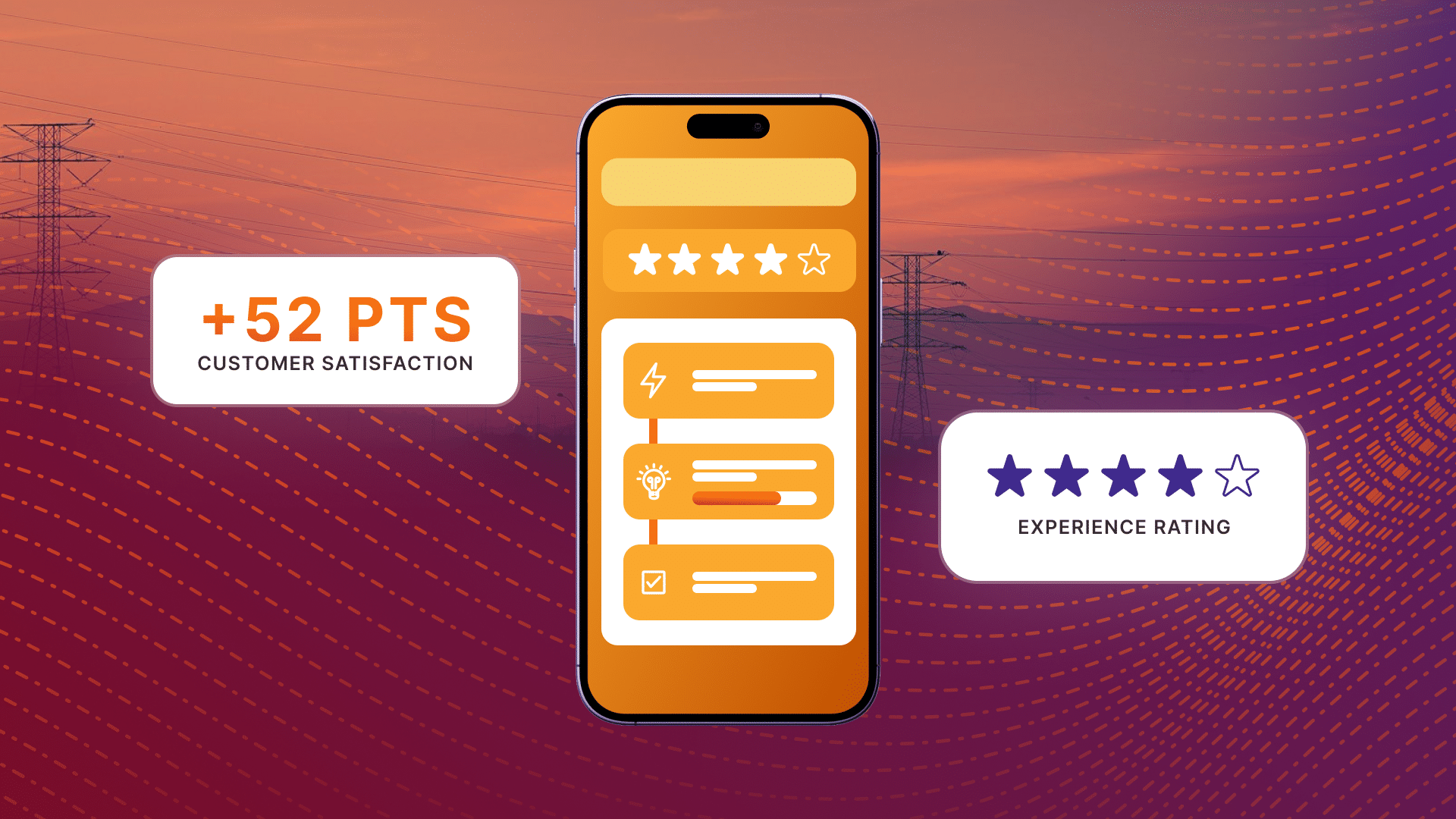
And in Mindgrub’s experience building these apps, we’ve seen customer satisfaction scores (CSAT) climb by 50 to 80 points after launch.
These come from different studies using different scales, so they aren’t a single number you can stack. What matters is that they agree. Across methods and measures, the app and the satisfaction lift show up together.
The lift comes from somewhere specific. The biggest driver is communication during outages, the single most stressful moment in the customer relationship. An app that pushes real-time status and a restoration estimate turns a frustrating information vacuum into something the customer can actually identify and plan around. The same logic applies to billing: a customer who can track their usage through the month and understand a higher bill before it arrives is a customer who doesn’t feel blindsided. Nothing builds trust and satisfaction like removing uncertainty when a customer needs answers most.
In Practice: Why Mobile App Is an Ideal Channel for Outage Communications
Chartwell’s analysis of more than 17,000 post-event customer surveys found that providing an estimated restoration time can improve outage satisfaction by up to 30%. Mobile apps are particularly well suited to this moment because they can deliver proactive push notifications directly to the device customers already have with them — without requiring them to search for the utility website, repeatedly refresh an outage map, or call for an update.
Scenario 1: Without an app
The power goes out. A customer searches for the utility website, reports the outage, then returns several times looking for updates. Without proactive communication, they may eventually call the contact center simply to find out whether a crew has been assigned or when power might return.
Scenario 2: With an app
The customer receives a push notification: “We detected an outage in your area. A crew has been assigned. Estimated restoration: 9:00 PM.” As conditions change, updated estimates arrive automatically on the same device. The outage itself hasn’t changed, but the app turns a reactive search for information into a proactive, personalized communication experience, reducing uncertainty while giving customers a clear reason to rely on the digital channel.
Ratings are a scorecard everyone can see
There’s a version of satisfaction a utility can’t hide from: the app store rating. It’s public, it updates constantly, and customers and competitors can both read it at a glance.
That makes it worth treating as a real target rather than an afterthought. A rating of 4.5 stars or better is a reasonable goal, but hitting it takes ongoing attention: maintaining the app and having a plan for how you respond to reviews.
The feedback itself is worth as much as the score. An app is one of the few channels where customers offer unprompted feedback on exactly what’s working and what isn’t. Those reviews become a running list of what to fix and build next, straight from the people using the product. Most utility channels don’t offer anything like that kind of direct, continuous signal. A strong rating, then, is both a satisfaction result and a source of the very feedback that keeps improving it. (We unpacked how utilities actually earn and keep those ratings in a dedicated playbook, including one that recovered from the mid-3-star range to 4.7.)
The customers who are hardest to reach
A mobile app also reaches customers other channels might miss. Lower-income customers are far more likely to rely on a phone as their only way online, without broadband or a desktop at home.
For those customers, a mobile app isn’t a convenience layered on top of other options. It might be the only way they can reach you at all. An app meets them on the channel they already use, which means the service improvements it brings reach some of the customers who have historically been the hardest to serve well. That improves satisfaction and equity at the same time.
How this connects to the rest of the case
Of the three, satisfaction is the hardest to put a number on. There’s no clean formula for it the way there was for cost savings or enrollment value. What there is instead is a baseline you can measure and then track. Some common measures include:
Customer outcomes: CSAT/J.D. Power measures, digital satisfaction, app-store rating, and review sentiment
Customer effort: successful logins, task completion, abandonment, and repeat attempts
Channel behavior: digital adoption, active users, and migration from assisted channels
Problem indicators: complaint volume, outage-related calls and digital-to-call escalation
Engagement: notification opt-ins, usage views, program enrollment and repeat app usage
Identify your goals for these benchmarks before launch, monitor them afterward, and you have something concrete to hold the project to, even without a dollar sign attached.
Satisfaction also doesn’t sit off to the side of the financial case. A satisfied, engaged customer is the same customer who enrolls in paperless, pays on time, and calls the center less. So the satisfaction an app builds quietly reinforces the savings and the value from the first two pieces. Rather than a separate soft benefit, it’s part of what makes the rest hold up.
The full picture
Cost savings get the app approved. Financial value makes it worth having. Satisfaction is what makes the relationship last. Together, they make a case that’s hard to argue with, and there’s still one question left: how an investment like this pays off in the long run. That’s where this series goes next.
This is the kind of thinking we help utilities work through: connecting what an app does for customers to a case you can take into the room. If you’re building the satisfaction side of that case, we’d love to connect. Get in touch with our team today to start the conversation.