Building the Business Case: How a Mobile App Creates Financial Value
Part of Meter to Mobile, a series on building the business case for a utility mobile app.
A utility mobile app has to earn its place in the budget. Knowing that an app would help support customers is the easy part. Proving it is worth the spend, to the people who actually control the spend, is where most internal business cases stall.
That’s what this series is for. Each entry takes one question a utility team has to answer before it can move forward with a new mobile application, and works through it with real numbers you can bring to your own stakeholders:
- The cost case: How much does a mobile app actually reduce customer service and operational costs?
- The financial value case: Where does a mobile app create direct financial value? (You’re reading it.)
- The satisfaction case: What does a mobile app do to customer satisfaction scores? (Coming soon)
- The long-game case: How do you justify an investment whose biggest payoffs build over time? (Coming soon)
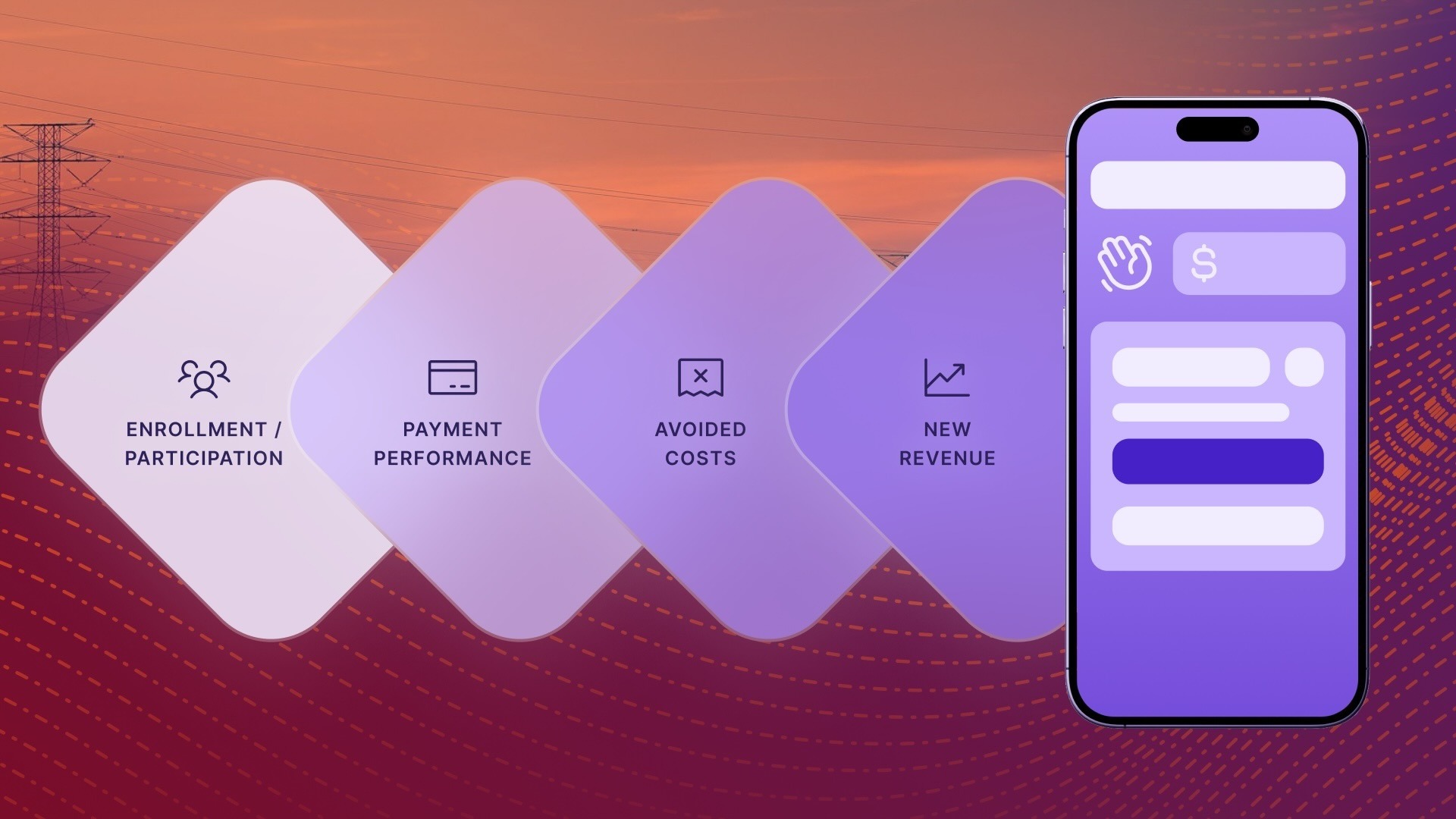
Part 1 looked at what a mobile app saves on the service side. This piece looks at the financial value it creates across the business: program participation, payment performance, operating costs it takes off the table, and the genuinely new revenue it can bring in.
Part 2: The Financial Value Case
A customer opens your app to check an outage, and before they close it, they’ve switched on paperless billing and set up autopay. Two enrollments, no call, no campaign, no postage. That kind of value is easy to miss because it doesn’t arrive as a single line on a report. It happened in the fifteen seconds a customer was already in the app.
This is the side of the business case that usually gets left out. Saving money on service is easier to picture, so it tends to dominate the conversation. But an app creates financial value in several ways, and some of those returns are often what tips the decision.
That value isn’t all the same kind, and the difference matters. Program participation, better payment behavior, operating costs the app removes, and genuinely new revenue all land differently on the books. It’s worth taking them one at a time, starting with the value that’s easiest to count.

Enrollment is where it starts
The most direct effect a mobile app has is on program enrollment and participation. A customer who would abandon a six-field web form halfway through will finish the same signup on a phone, because it’s a few taps with most of the details already filled in. That gap isn’t subtle. In Mindgrub’s experience, mobile converts enrollments at up to roughly three times the rate of desktop and web.
Paperless billing and AutoPay are the two that convert best, and they’re worth leading with because both lower the utility’s costs directly: paperless removes print and postage, and AutoPay improves payment timing. From there, the app becomes the easiest place a customer will ever enroll in anything: budget billing, new rate plans, EV programs, and demand response. In one case, a utility partner of ours saw about a third of customers who weren’t already on paperless opt in when the app prompted them to.
Example
For example, if we assume 100,000 customers are eligible for paperless billing, the app produces a 10% incremental enrollment rate, and each enrollment avoids $10.00 per year in print, postage, and handling costs.
| Eligible Customers | 100,000 |
| App Enrollment Rate | 10% |
| Annual value per enrollment in app | $10.00 |
| Recurring annual value | $100,000 |
Demand response is the clearest case of enrollment turning into real value. A customer who’s enrolled can be prompted through the app to ease off usage during a peak event, and rewarded for doing it. The app is one of the few channels that can reach them in real time when it matters most. What that participation saves shows up later, and we’ll come back to it.
For the business case, participation is the number to lead with because it’s the easiest to model. You can tie a conversion rate directly to a known per-enrollment value and show your work.
Payment performance
The app also changes how and when customers pay for the better.
Push notifications reach a customer before a due date in a way an email rarely does. Think of the customer who means to pay, but keeps forgetting until a late notice arrives. A push notification catches them at the right moment, and one-tap payment lets them pay the bill before they’ve even set the phone down. Together, those features move payments earlier, increase completion rates, and cut down on transactions that are started and then abandoned. The data supports this: a large utility recently reported a 97% completion rate for payments made in its mobile app. That’s higher than web, mobile web, or its IVR.
One customer paying earlier instead of late is a small thing on its own. Across a whole customer base, it adds up to steadier cash flow and fewer accounts sliding into collections. Better payment habits don’t just improve timing. They also lower costs.
Avoided operational and system costs
Part 1 covered the operating costs an app removes on the service side, mainly deflected calls and avoided truck rolls. The enrollment and payment behavior in this piece removes a second layer of cost, one that flows from the value levers above rather than from call deflection, so it counts separately.
- Every paperless enrollment removes a recurring print-and-postage cost.
- Every app user reduces use of higher-cost channels including agent and IVR.
- Every customer who pays on time is one who doesn’t move into disconnection or collections, which means less bad debt written off, fewer service-disconnection workflows, and less collections activity.
- Every customer who eases usage during a peak event, prompted through the app, is demand the utility doesn’t have to meet when power costs it the most.
While this is not direct revenue, it’s real money, it adds up every year, and it’s the kind of avoided cost a finance team already tracks, which makes it easy to point at when you build the case.
True new revenue
Everything so far either raises participation, improves payment, or removes cost. The last category is different: money the utility didn’t collect before at all. This is the least certain of the four, and how much it returns depends heavily on your programs and your market. But the app is what makes it reachable.
A marketplace built into the app can sell energy-related products directly to customers. PPL Electric Utilities runs one, an online store where its customers buy smart thermostats, air purifiers, weatherization supplies, and similar efficiency products at customer-only pricing. Placed inside an app the customer already opens for billing and outages, that storefront reaches people a standalone website might not.
Service offerings work the same way. Entergy’s Power Through program sells commercial customers a subscription to backup power: Entergy installs and maintains a standby generator, and the customer pays a fixed monthly fee instead of a high upfront cost. That’s recurring revenue built on the utility relationship, and an app is a natural place to surface and manage it.
These are harder to forecast than the other three categories, and the right number depends entirely on what a given utility chooses to offer. Even conservatively, it’s revenue a call center or a web portal can’t capture, and only the app can.
Put your own data to work
You don’t need a vendor to evaluate this. You need your own enrollment data. A simple starting estimate:
Eligible customers × mobile conversion lift × value per enrollment = your annual enrollment opportunity
Plug in your own numbers and start conservative. Even then, the participation figure alone tends to surprise people, and the payment performance, the avoided costs, and the new revenue all sit on top of it. Set that total beside the cost savings from Part 1, and you’re no longer arguing that an app might help. You’re showing what it returns.
The full picture
Cost savings get the app approved. The financial value it creates across enrollment, payments, avoided costs, and new revenue is what makes it worth having. A business case that shows both is hard to say no to.
This is the kind of modeling we help utilities work through: connecting the enrollment, payment, and program data you already have to a number you can take into the room.
If you’re building the financial value side of your case, we’d love to connect. Get in touch with our team, and we’ll help you run those numbers.