Meter to Mobile: Building Your Mobile Application Business Case
Part of Meter to Mobile, a series on building the business case for a utility mobile app.
A utility mobile app has to earn its place in the budget. Knowing that an app would help is the easy part. Proving it is worth the spend, to the people who actually control the spend, is where most internal business cases stall.
That’s what this series is for. Each entry takes one question a utility team has to answer before it can move forward with a new mobile application, and works through it with real numbers you can bring to your own stakeholders:
- The cost case: How much does a mobile app actually reduce customer service and operational costs?
- The financial-value case: Where does a mobile app create direct financial value? (Coming soon)
- The satisfaction case: What does a mobile app do to customer satisfaction scores? (Coming soon)
- The long-game case: How do you justify an investment whose biggest payoffs build over time? (Coming soon)
We’re opening with one of the largest business case drivers for a new customer mobile application – reducing call center costs. How much does answering the same customer questions over and over actually cost your utility, and how much of that can a well-built app take off the table? This piece breaks down where those costs sit and gives you a simple way to size the savings for your own business case.
Part 1: Reducing Call Center Volume
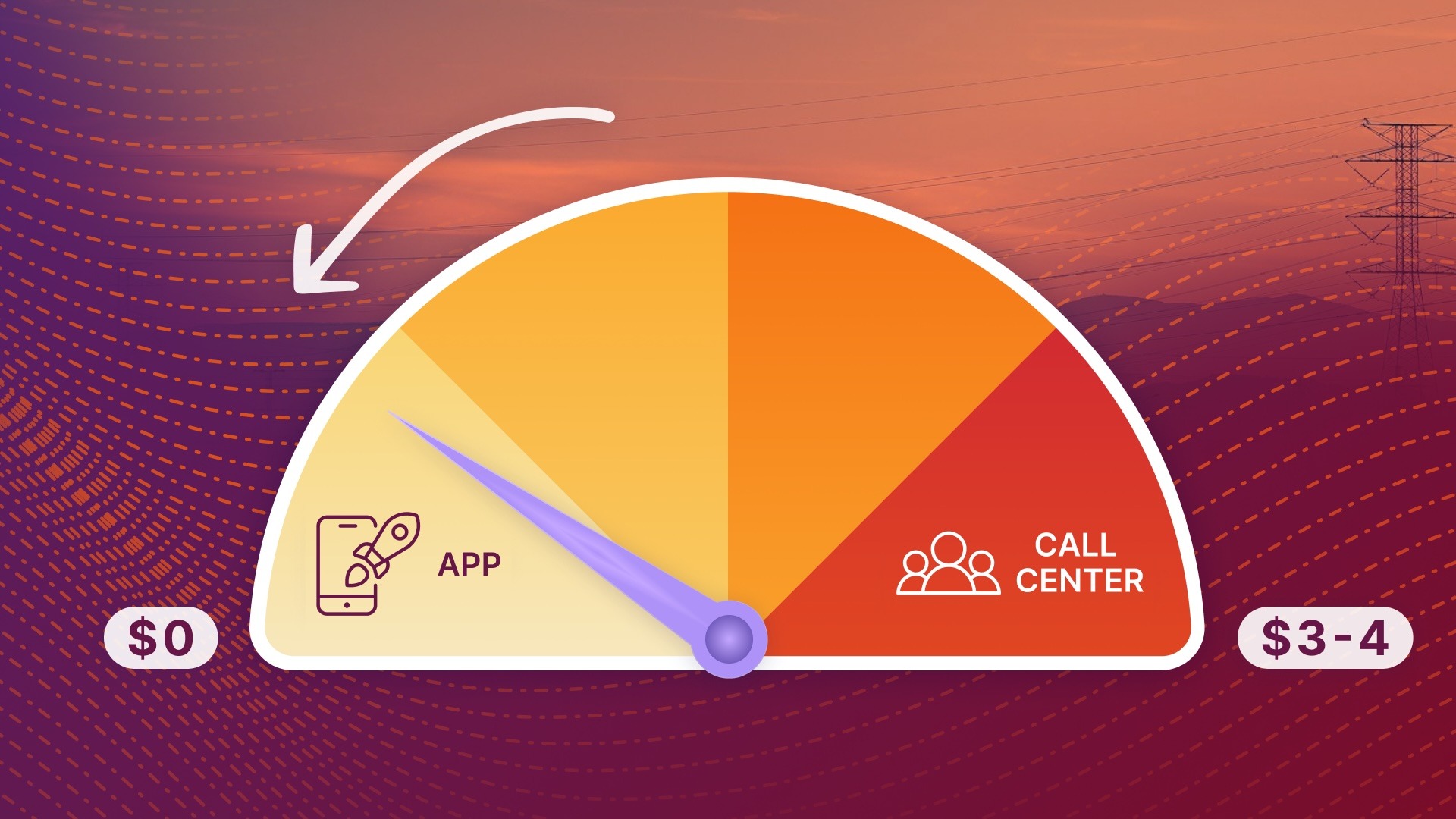
Every time a customer calls your utility, it costs money. Not in the abstract. A real, countable amount, estimated between $3 and $4.00 per call. Multiply that across a service territory of hundreds of thousands of customers, then picture what happens to that number during a storm. The call center stops looking like a support function and starts looking like a cost center with a dial you can turn.
That dial is your channel mix, the set of ways a customer can reach you, each one carrying a wildly different cost per interaction. For most utilities, the most cost-effective channel is a mobile app, and it’s also the most underused.
What the call center actually costs
The per-call figure is only the baseline. The real expense lives in volume, and utility call volume is famously spiky. In Mindgrub’s experience working with utilities, engagement during an outage event can surge to 5–10× normal levels, exactly when each call is least differentiated and most automatable. A large share of that surge is a single question asked thousands of ways: Where is my outage, and when will it be fixed?
These are high-volume, low-value calls. They don’t need a human to resolve. They need information that the customer can’t currently get any other way. That’s the opportunity hiding in the cost.
What shifts when customers self-serve
When customers can answer their own questions, the divertible calls leave the queue. The channel best positioned to absorb them is a mobile app – self-service that lives in the customer’s pocket rather than waiting for them to seek out a web portal. In our research, Mindgrub has found that utilities investing in self-service adoption can target call-volume reductions on the order of 15–25%.
Outage information is the clearest win. Real-time status and proactive push notifications remove the reason for the call before it’s made. The customer who gets a notification with a restoration estimate doesn’t pick up the phone.
And here’s where self-service via mobile apps addresses a second, quieter problem. Outage reporting on the web suffers from high drop-off. Customers start a report, hit a login wall or a clunky multi-step flow, and abandon it. Then they make a call instead, pushing volume back to the most expensive channel at the worst possible moment. A mobile app cuts that friction in two ways: biometric and saved-password sign-on removes the login barrier, and unauthenticated submissions let customers report an outage without signing in at all. Each abandoned web report that becomes a completed app report is a call that never needs to be placed.
The savings don’t stop at the call center. Better customer-reported outage data reduces unnecessary truck rolls in the field, which are expensive. Industry estimates for the cost of a single truck roll commonly land somewhere between $150 and $500, and some run higher still. Capabilities like meter ping, which confirms whether power is actually out before a crew is dispatched, cut down on trucks sent to investigate outages that have already cleared. Exelon built this kind of functionality into its mobile work, with meaningful operational savings to show for it. That’s cost reduction across two separate cost centers, customer service and field operations, driven by the same underlying capability. Two line items, one capability — the kind of detail that makes a cost justification harder to argue with.
The bill is the bigger story
Outages get attention, but billing drives more call volume day-to-day. The single most common reason a customer calls is some version of why is my bill higher this month? It’s also one of the most answerable questions without a human, if the customer has the right information in front of them.
A mobile app puts it there. Usage data shown in context, bill-to-bill comparisons, and plain-language explainers let a customer see for themselves that a hot week ran the air conditioning harder, or that an extra billing day pushed the total up. The question gets answered before it becomes a call. Proactive high-usage alerts go a step further and flag the trend mid-cycle, so the customer isn’t surprised when the bill arrives and never picks up the phone to begin with.
The payment side compounds the effect. Saved payment methods, one-tap payments, autopay, and paperless enrollment turn multi-step web flows into a few taps, which both deflects billing calls and lifts completion rates. The transaction data bears this out: a large utility recently reported a 97% completion rate for transactions on its mobile app, higher than web, mobile web, or its phone system, with the biggest year-over-year gains coming from account-inquiry and outage-related transactions. Every transaction that completes in the app is one that doesn’t stall out and land in the call queue.
Why mobile specifically
It’s worth being precise here, because “digital” gets used loosely. A good web portal does real work, but it waits for the customer to come to it. A web portal absorbs a customer who chooses to go look. But a mobile app reaches the customer who otherwise would have called, before they call.
That mechanism is also the cheapest one a utility has at its disposal. Even better, it’s on demand. Push notifications carry little to no marginal cost per message, so the channel gets cheaper per interaction as volume grows, the opposite of call centers, print, and SMS, all of which cost the same or more as volume climbs.
That low cost cuts the other way too. The same push notifications displace print, SMS, and outbound-call spend that a utility already pays for. A single channel that deflects inbound calls and replaces outbound messaging is cutting costs from both directions.
For high-volume, informational interactions, no other channel moves them at a comparable cost.
Put your own data to work
You don’t need a vendor to size this opportunity. You need your own call data. A simple way to estimate it:
Annual call volume × cost per call × % of calls that are divertible = your annual call-deflection savings opportunity
Start conservative on the divertible percentage,and the number still tends to surprise people. And that only covers the call-center side of the ledger. It doesn’t even begin to account for avoided truck rolls, reduced outbound messaging spend, or the enrollment gains a mobile channel drives elsewhere. The point isn’t a precise total. It’s that the savings are real, estimable, and compounding – and that any utility can seize the opportunity for itself before talking to anyone. That figure is usually the number your finance team scrutinizes first, so it’s worth getting it from your own data rather than a vendor’s slide.
None of this is free, of course. A mobile app is a real software investment, with development, maintenance, and licensing costs that belong in any honest cost justification. The case for it isn’t that it costs nothing. It’s that the deflected calls, avoided dispatches, and displaced messaging accumulate year after year, while the build is mostly a one-time cost. The savings are what pay the investment back, and they keep going long after it has.
Close
The call center isn’t going anywhere, and it shouldn’t. But a meaningful share of its volume is informational, divertible, and most expensive at exactly the moments it matters most. The channel mix is a cost lever, and mobile is the cheapest effective place to absorb that volume. It’s also the first number worth bringing to leadership when you make the case internally.
This is the kind of problem we help utilities work through: mapping where that volume actually sits and building the mobile experience that moves it. If you’re trying to put real numbers to your own call data, we’d love to compare notes.
Get in touch with our team today, and we’ll help you run those numbers.