One Customer, Four Days: What EMACS 2026 Taught Us About Earning Trust
A four-day wait: why utility customer trust is on the line
Imagine a customer named Maria whose utility payment fails on Monday. The system records the failed payment, but no one follows up.
By Wednesday, Maria is worried and calls customer service. The representative creates a case and sends it to the billing team. The issue was finally resolved on Friday.
Technically, every team did its job and met its performance targets. But from Maria’s perspective, it took four days to resolve a simple payment issue, and she had to take the initiative to get help. What looks like a successful process internally feels like a frustrating customer experience.
That story was shared at EMACS 2026, Chartwell’s annual utility customer experience conference, in a session on why utilities with plenty of data still struggle to act on it. It stuck with me for the rest of the week. I found myself asking the same question: what could have changed Maria’s week?
It’s an increasingly urgent question. Chartwell’s 2026 residential consumer survey found that 21% of consumers paid a utility bill late in the past year to cover other bills, and one in five received payment assistance or an extension. 44% said their household budget is tighter than last year. Lower-income households feel it most, but the strain seems to be impacting more people than ever. For a customer on a tight budget, four days of not knowing where a payment stands is a long time.
Utilities feel the pressure from their side, too. Grid modernization, data center load growth, and digital investment all cost money, and regulators are scrutinizing rate cases more closely than ever. In her keynote, Georgia Power CEO Kim Greene argued that growth can benefit customers rather than burden them, as long as large users like data centers pay for the infrastructure built to serve them. The Trust Collision executive panel made the case that as costs rise, customer confidence becomes one of a utility’s most valuable assets.
By the end of the week, four themes emerged and reflected challenges we see in our own work with utility digital teams.
Key takeaways:
- Prevent billing problems before they start. Catch bad data before it reaches a bill, and make sure essential interactions, including login and payments, are easy to complete.
- Reach customers proactively. Use existing data to contact customers before a problem turns into a phone call.
- Break down organizational silos. Give billing, the contact center, and digital teams one shared view of the customer and clear decision owners.
- Fix the foundation before adding AI. Clean content and clear rules are what make AI and automation reliable.
1. Stop billing problems before they start.
Nobody gives a utility credit for a bill that arrives on time and is correct. But they do notice immediately when it isn’t, and a bad bill is how a lot of weeks like Maria’s begin.
Con Edison’s Daniel Sam referred to billing as a trust moment, and his team treats it like one. Their goal was to catch problems before a customer ever saw them, instead of fixing them after the customer called. So they automated the handling of billing exceptions: accounts the billing system can’t bill on its own, such as those with a missing meter read or a move-out that never got a final bill.
The automation runs every day, checking accounts that are close to missing their billing window, and takes a larger pass on weekends. When a meter read is missing, it uses an estimation method approved by regulators. New rates are checked before they go live, so no one gets billed at the wrong one. The work has processed 2.6 million transactions, resolved exceptions 60% faster, and cut manual effort by 70–80%, all without a noticeable rise in calls to the contact center.
Customers never see any of this. They just get a correct bill on time, and one less reason to have a week like Maria’s.
The same rule applies to mobile apps. If Maria had opened her utility’s app on Monday to check on her payment, could she have gotten in? In our 2026 Utility Benchmark Report, the most common complaint in one-star reviews was trouble logging in. Customers give an app one or two chances before they uninstall it and go back to the website or their phone.
Try this: Before adding new digital capabilities, evaluate how easily customers can log in, make payments, and report outages. Monitor completion rates, failures, and points of abandonment. These everyday interactions have an outsized influence on customer satisfaction.
2. Reach her on Monday with proactive outreach.
The simplest fix for Maria’s week is someone reaching out the day her payment failed. Several utilities at the conference identified ways they are already using the data they have to contact customers before a problem turns into a phone call.
- National Grid launched push notifications this year, starting with an alert that a new bill is ready. About 20% of customers click through, well above the utility’s other outreach channels.
- Entergy uses propensity-to-pay models to identify customers at risk of falling behind. The app then offers the program most likely to help, such as a deferred payment arrangement, an extension, or energy-saving tips, all before the customer calls.
- Utilities such as Mississippi Power and Entergy use Single Stop, a nonprofit tool that helps customers find assistance for food, housing, and utilities through a web form that takes about 15 minutes to complete. It requires no account login or Social Security number. The two utilities promoted Single Stop to all of their customers, not only those behind on payments, so no one feels singled out for needing help.
- Con Edison plans to move its AI knowledge tool from answering searches to offering guidance. When a customer mentions a high bill or a low-income program, the system would surface answers before the rep searches.
What connects these examples is a shift from simply collecting customer data to using it to improve the experience.
Proactive communication is especially effective when it’s actionable. A notification about a failed payment becomes much more valuable when the customer can immediately retry the payment, select another method, or explore assistance options.
The speaker who shared Maria’s story had a name for what went wrong: decision latency. The utility had the information on Monday. Nothing connected it to an action, so every team did its job, and she still waited.
That’s the kind of gap our Decision Engine is designed for. It works on top of a utility’s existing systems, applies business rules as events happen, and routes each action or exception to the team that owns it.
Try this: Pick one customer event you already track, like a failed payment or a missed meter read, and map the first 24 hours after it happens. Who finds out, and who acts?
3. Break down silos between billing, customer service, and the digital teams.
In Maria’s story, the contact center and the billing department each did their part. They just weren’t working from the same picture.
PSE&G’s David Johnson told a story that made this problem easy to visualize. At community events, the utility’s energy efficiency and energy assistance staff sometimes set up separate tables without knowing the other was there. A customer would stop at one table, walk a little farther, and find another from the same company. Similar divisions existed behind the scenes, PSE&G had two data analytics teams and two technology teams competing for the same budget. Some customers even had multiple logins because different teams had built different digital tools.
The fix began when PSE&G’s president challenged the company to become one team speaking with one voice. Consolidating those logins is now a top priority, supported by two other changes in how teams collaborate and make decisions:
- A monthly customer council | Officers from across the company, including legal, regulatory, and communications, meet to discuss nothing but customers. The meetings have given leadership a clearer view of why customer investments matter when they compete with poles and wires for budget.
- EX = CX | Johnson’s team treats employee experience as the foundation of customer experience. When employees lack the tools to do their jobs well, customers feel it.
National Grid’s Helen Tang described the same shift from a digital perspective. Instead of planning channel by channel, her team maps the full customer journey, finds the points with the most friction and manual effort, and then decides which channel suits each task.
A panel on data and decision-making showed how common the problem is. When asked what would most improve coordination across the enterprise, 54% of attendees chose clear cross-functional ownership and decision rights. Several utilities admitted that even for an outage message, it isn’t always clear who has the final say.
Try this: For your five most common customer problems, name the person who owns the decision. Wherever you can’t, start there.
4. Give reps the right answer in five seconds with AI.
When Maria finally called on Wednesday, the rep needed a fast, correct answer. At Con Edison, finding one now takes about five seconds.
ConEd’s Richard Brown and Tatyana Gorokhova walked through the generative AI assistant they built for customer service reps on the Oracle knowledge platform the company already used. Reps ask a question in plain language and get an answer roughly 36 times faster than searching the old repository. First-call resolution rose from about 60% to 79%, and every answer links to an approved source the rep can check.
The part of their story that stayed with me happened before launch. ConEd’s knowledge base had built up over many years, and much of it was outdated, duplicated, or contradictory. The team reviewed every document, archived what wasn’t needed, and restructured the rest. Early tests showed about 70% accuracy, and plenty of teams would have shipped it there. ConEd held the launch until it reached its 85% target, and Brown called getting the content in order the most important of their five lessons.
ConEd’s billing team took a similar approach. Before automating anything, they watched and recorded reps working real accounts and found gaps between the documented process and what people actually did. They confirmed rules with process owners first and built the code from reusable components, so one rule change wouldn’t mean updating five automations.
In another presentation, Duquesne Light and its research partner, Bellomy, told a parallel story about customer surveys. When Duquesne refreshed its CX program, it found a 20-minute satisfaction survey, overlapping questions, and data some teams had stopped using years earlier. Trimming the program made it easier for customers and more useful inside the company.
Try this: Before you put AI in front of reps or customers, audit the content and rules it will draw from. AI and automation are only as reliable as what’s underneath them. And if they’re not reliable, reps and customers would rather they not be there at all.
Entergy offers a real-world example with its AI Assist chatbot, which uses a combination of knowledge articles, semantic search, and multilayer intent detection to help customers navigate billing questions, report outages, and complete self-service tasks. Since launching in September 2025, the chatbot has handled more than 216,000 conversations, demonstrating how a well-structured foundation can turn AI into a practical customer service tool.
Spotlight: what makes a utility mobile app a lifeline
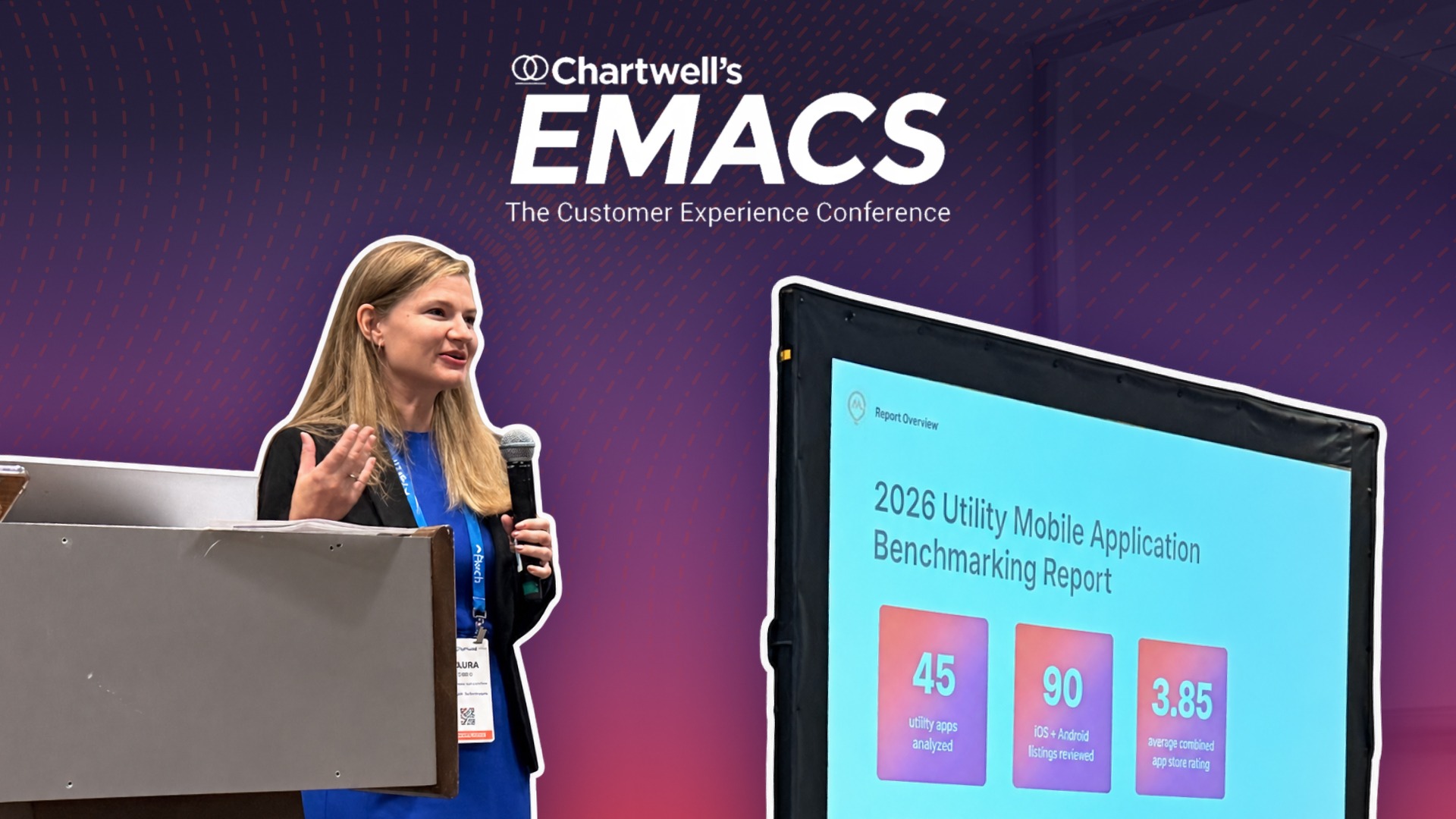
For a lot of customers, the mobile app is where a week like our Maria’s plays out. It’s where she checks whether a payment went through, gets an alert, or decides she has to call. That’s what I wanted to explore on our panel, “The Mobile App as a Customer Lifeline”, with Helen Tang of National Grid, Kalen Bruce of LG&E and KU, Karlon Butler of Entergy, and Brian Stafford of PPL. Their apps range from 10 months to eight years old.
I opened with findings from our benchmark report:
- Only 13 of the 45 utility apps we reviewed reached 4.5 stars, the mark we consider the gold standard.
- 24 apps declined in rating year over year, and only 10 improved.
- iOS apps averaged 3.91 stars, compared with 3.77 on Android, where device variety makes testing harder.
- Payment complaints rose sharply from last year, in step with rate increases across the country.
The leading apps make paying simple, explain each customer’s bill and usage in personal terms, and tell customers what’s happening before they ask. The panelists showed what that takes:
Listen to customers and act on their feedback.
- Read every piece of feedback. For five years, Karlon has spent 40 to 45 minutes every Monday morning reading customer feedback. Last year, about 768,000 customers left feedback, and he read every response. What he reads shapes Entergy’s roadmap. It’s why the app added native Apple Pay and Google Pay in 2025 instead of sending customers to a third-party payment page. He sends executives a one-slide summary of what customers are asking for and how his team will respond.
- Respond to reviews quickly. Kalen’s team at LG&E and KU pulled together call center quality assurance staff, a former call center supervisor, and analysts to monitor and answer every low rating. Dedicated IT support lets them fix real bugs fast. Some customers have changed one-star reviews to five stars after a follow-up.
- Ask for ratings at the end of a task. National Grid’s in-app review prompt appears after a customer completes a payment. Satisfied customers are invited to rate the app in the store, and unhappy ones go to a short survey so the team can follow up.
Make essential tasks easy and relevant.
- Leave some features on the website. Brian’s team kept its first release focused on core tasks. Start, stop, and move service and payment assistance handoff to the website while the customer stays signed in. Helen made a similar point: an app is not a smaller copy of the website, and too many options overwhelm people. Show each customer the next step that fits their account.
- Put affordability help on the home screen. When a customer is past due or scheduled for disconnection, Brian’s app shows a banner with a direct path into payment assistance.
Treat mobile as an ongoing product, not a one-time project.
- Building a sustainable mobile app roadmap is essential. Operating systems, devices, back-end systems, and customer expectations keep changing. An app without a roadmap, budget, and product owner will slip in the ratings, and that slide happens in public. If you can’t sustain an app, put the money into your responsive website instead.
- Promote the app everywhere. Entergy has made mobile app adoption an ongoing priority. For example, Entergy put a QR code on the paper bill and now sees about 300,000 downloads a year. Karlon also sees a spike every August, when college students move into their first apartments. With each contact center call costing $6 to $8, he said, an app customers use pays for itself.
Try this: Evaluate potential mobile features using the desirability, viability, and feasibility (DVF) framework. Consider whether customers need the capability, whether it supports business objectives such as satisfaction and call deflection, and whether it can be delivered and maintained effectively. Then prioritize opportunities based on impact and effort to build a practical roadmap.
Her week, replayed: 5 questions for your 2027 roadmap
Here’s how Maria’s week could have gone. On Monday, her payment fails, and within the hour she gets a notification with a link to pay another way or set up an arrangement. She opens the app and logs in on the first try. If she still calls, the rep can see what happened and has an answer in seconds. It’s settled on Monday, not Friday.
Every piece of that week already exists at a utility somewhere in this post. The work ahead is putting the pieces together. Five questions to take back to your team:
- Are essential digital experiences working as expected? How do you measure customer success when logging in, making payments, and reporting outages?
- Where do you already have data to act early, such as a failed payment, a missed meter read, or a rising bill, but no connected way to act on it?
- Who makes the final call on customer-facing messages, and does every team know?
- Are your knowledge base, process documentation, and survey program clean enough to trust AI with them?
- Does your app have a funded, multi-year roadmap and a dedicated product owner?
Maria’s week is a “now” problem. At our booth, we asked EMACS attendees to look further ahead. Utility leaders added their ideas in three parts: what customers need most now, what they’ll need next as technology and expectations change, and what they’ll need three to five years out. We’re pulling those answers together into our upcoming Horizon Report, a look at where utility customer experience is headed, from the people working on it every day.
In the meantime, download the 2026 Utility Benchmark Report to see which utility apps lead the industry, the trends shaping the next year, and a roadmap you can take back to your team. And if you’d like to talk through your own digital priorities, let’s connect.