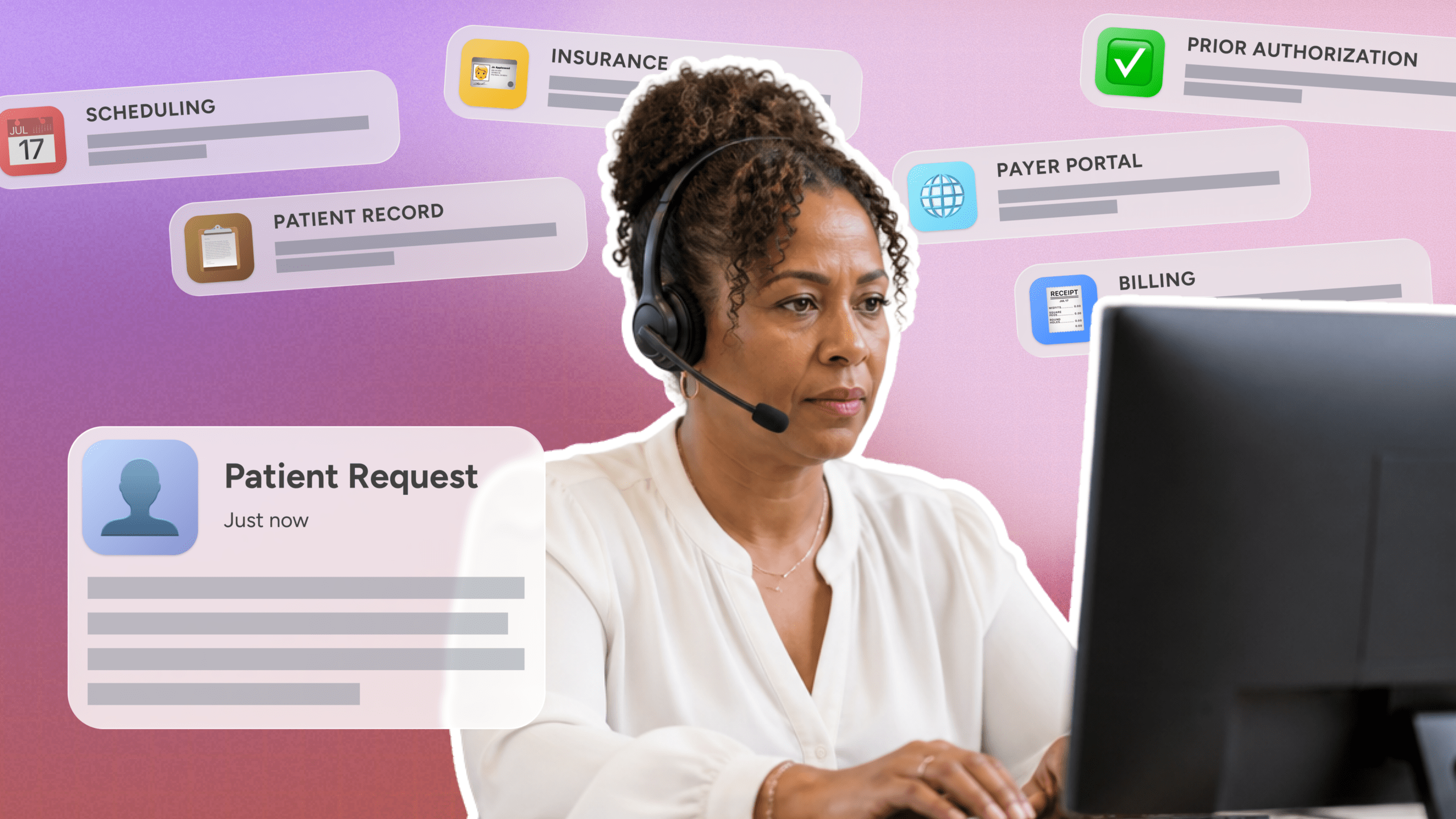
“Let me check another system and call you back.”
Your patient access teams say some version of that dozens of times a day.
You’ve invested millions in enterprise software platforms. Your systems are technically connected via APIs. Yet your front-line teams still spend hours manually bridging the gaps between them.
APIs move data. They do not make decisions. When a patient’s question requires someone to pull data from several places, interpret it, and decide what happens next, a person does that work. Your staff has become the layer that connects your software platforms together. They are functioning as human APIs, and it costs you.
The Organizations That Run on One Person’s Memory
Every patient access or billing office has an “Elena.”
Elena is the veteran coordinator who holds the unwritten rules of your operations in her head. She knows instinctively that Payer X requires a specific authorization format for a cardiology follow-up, even when nothing in the software flags it. She understands the exceptions, the historical nuances, and the workarounds.
That knowledge is valuable, and it’s a risk.
If Elena is out sick or moves to a new role, it leaves with her, because it lives in her head instead of in your systems. Coverage slows down, backlogs grow, and two patients with the same question start getting two different answers.
Where the Cost Shows Up
When institutional knowledge is your only bridge, daily operations become slow and guarded. This drag hits healthcare organizations across two distinct failure points.
-
The Administrative Five-Tab Shuffle
When a patient calls to confirm their upcoming appointment balance and insurance coverage, Elena (or whoever is covering for her) opens the EHR for scheduling data, logs into the RCM platform for financial balances, and navigates an external payer portal to verify eligibility. The staff member is forced to stitch together several systems by hand just to answer a basic question.
About half of those calls never get resolved on the first try. Health system call centers report first-contact resolution near 52%, against a cross-industry target of 70 to 79%. Handoffs between departments and scheduling silos send the rest to the callback queue. Handle times run 6 to 6.6 minutes for a routine call and stretch to 8-10 minutes once a specialist referral or multi-facility scheduling is involved.
-
A Patient Cancels at the Last Minute
In high-volume outpatient clinics, a last-minute cancellation immediately shows up in the scheduling system. However, the software lacks the intelligence to fix the vacancy.
A staff member reviews the waitlist, evaluates the proximity of patient locations, checks provider availability, and verifies insurance compatibility. Because the decision sits with one person, the slot often goes unfilled. The provider sits idle, and the revenue is gone.
The Cost of Manual Coordination
Eligibility verification shows how fast the timeline flattens once the coordination is automated. Checked manually, confirming a patient’s coverage means calling the payer or logging into a portal one at a time.
Run as an electronic query across the EHR, practice management system, and clearinghouse, the check returns in real time — CAQH puts the savings at about 16 minutes per verification. The stakes are more than time: 46% of claim denials trace to missing or incorrect information, the kind of error a real-time check catches before the claim goes out.
Eligibility is only one transaction. The same pattern runs through prior authorization, claim status checks, and benefit inquiries, each one a point where staff stands in for logic the system could carry. Across the volume of checks a health system runs in a week, those minutes are the real cost of keeping people in the middle.
Why Pipes Can’t Solve a Brain Problem
So why hasn’t more integration fixed this? Many healthcare IT leaders try to solve these bottlenecks by building more point-to-point integrations. Others deploy basic chatbots to handle front-end inquiries.
But these approaches don’t address the core issue because data connectivity is fundamentally different from decision orchestration.
An integration platform (iPaaS) functions like water pipes. It moves data between your systems. But moving data doesn’t solve the decision problem; your staff is still responsible for verifying, interpreting, and deciding what to do with it.
True efficiency requires an intelligent layer: a system that understands what the patient wants, applies your complex compliance protocols, and routes actions across your backend platforms in real time.
An Orchestration Layer Above the Systems You Already Run
The Mindgrub Decision Engine is that layer. It serves as an orchestrator and navigator that sits directly above your legacy software silos.
Instead of forcing staff to hunt for data, the engine interprets patient intent in real time. It orchestrates multi-system decisions, validating identity, coverage, and scheduling availability in a single pass.
A request that used to bounce across three systems and land in a callback queue resolves in about 25 seconds from a single interface, without replacing your existing software stack. The logic that was once stored exclusively in a staff member’s head is now handled by your system, freeing your team up to focus on patient care.
See Where Your Systems Are Costing You Time and Trust
Most health systems don’t know how much this is costing them until they look. Faster patient access, less front-line burnout, and the ability to scale without adding headcount all start with the same question: how much of your operation still runs on tribal knowledge?
If that’s a gap you’re trying to close, a short conversation can map where fragmented systems create friction and where an orchestration layer can help. Reach out to our team today to learn more about how Decision Engine by Mindgrub could work alongside the software you already run.